History of Pixel Art Gaming
We live in an age where game characters have individually rendered pores and hair follicles that react to the wind. It's technically incredible, but honestly? I still find myself getting more hyped about games made out of tiny, blocky colored squares. I've been thinking a lot about why pixel art hasn't just survived the 3D revolution, but is actually thriving more than ever on platforms like Movuter Arcade. It's not just a cheap shortcut or a hit of nostalgia—it's a completely distinct art form.
Born Out of Necessity
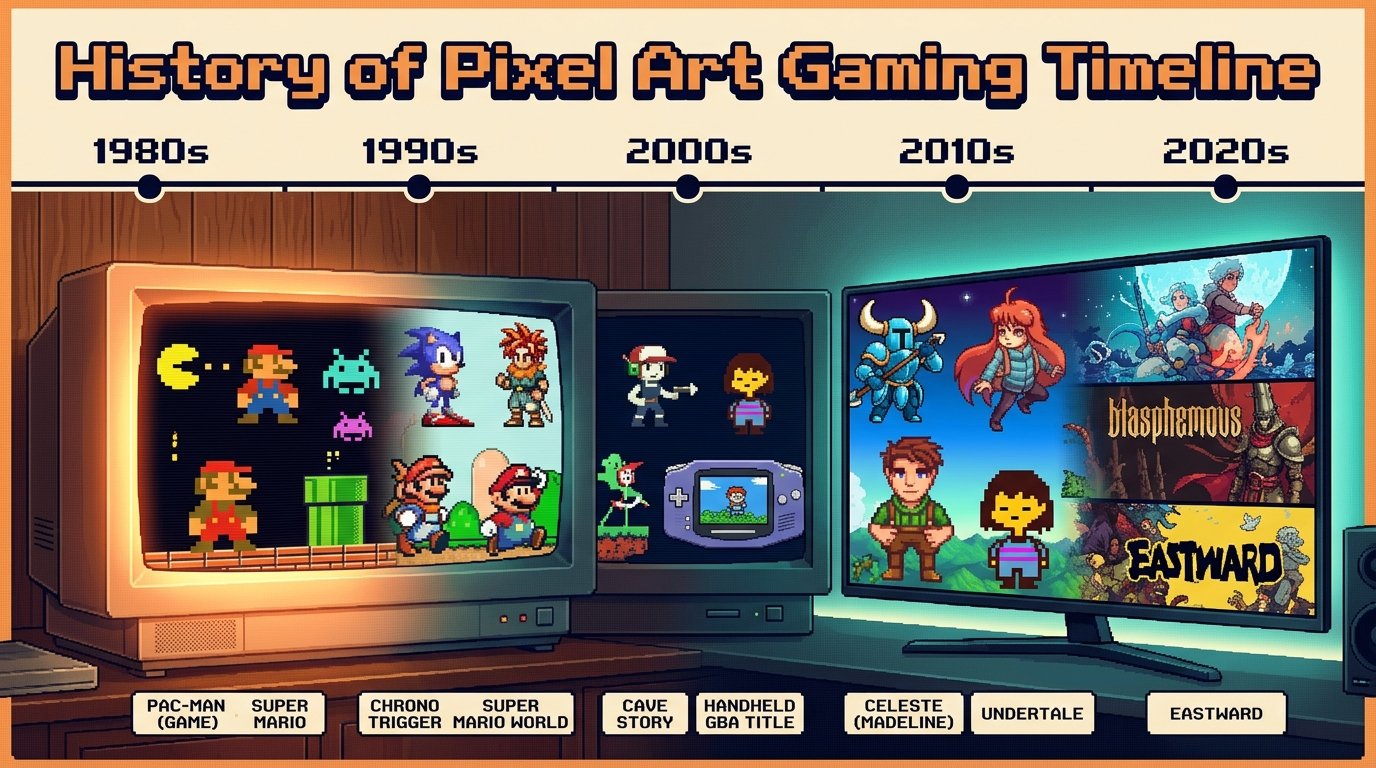
Back in the late 70s and early 80s, developers weren't choosing pixel art—they were stuck with it. The Atari and early arcade boards had the computing power of a modern toaster. Drawing smooth curves in real-time would have instantly crashed the hardware.
So, they worked on grids. Think about the aliens in Space Invaders or Pac-Man. The artists had maybe an 8x8 or 16x16 square to work with, and they had to make something that didn't just look like a blurry glitch. Every single pixel placed was a massive decision. Because they only had a handful of colors, they essentially created a new visual language. They gave us the bare minimum of a shape, and our brains happily filled in the rest of the details.
The Golden Age of 16-Bit
When the SNES and Genesis rolled around, pixel art went from a limitation to a genuine flex. Suddenly, developers had hundreds of colors. They didn't have to just make symbolic shapes anymore; they could make actual art.
This is when we started seeing stuff like dithering (making a checkerboard pattern of two colors to fake a third color or a shadow) and massive, sweeping background landscapes. If you look at the backgrounds in late 90s fighting games or platformers, the amount of detail packed into a tiny resolution is staggering. Characters finally had readable facial expressions and smooth animations. The 16-bit era proved you didn't need 3D polygons to build a living, breathing world.
The CRT Secret We All Forgot
Here's the thing that gets lost when we play retro games today on a 4K monitor: pixel art was never meant to look perfectly sharp. The artists drew those sprites specifically for heavy, curved CRT televisions.
CRTs draw images using a beam that scans across the screen in lines. The glow from the screen would naturally blur and bleed the pixels together. That checkerboard dithering pattern I mentioned earlier? On a CRT, your eyes literally couldn't see the blocks; they just saw a smooth, perfect shadow. When you look at raw pixel art on an LCD screen today, it looks jagged. But on an old TV, it looked round and soft. That's why so many modern pixel art games give you an option to turn on a "CRT Filter." It's not just for nostalgia—it's actually how the art was meant to be viewed.
The Modern Revival
For a while in the 2000s, pixel art was basically dead. Everything had to be 3D. But then indie developers brought it back. At first, it was just because making 3D models was too expensive for a two-person team. But it quickly became a style choice.
The coolest thing happening right now is developers breaking all the old rules. They take 16-bit sprites and throw them into game engines with modern lighting, real-time shadows, and crazy particle effects that a Super Nintendo would have exploded trying to render. It's this weird, beautiful hybrid of retro limitations and modern horsepower. And because the file sizes are so small, it's absolutely perfect for browser gaming.
Keeping It Crisp
Modern screens are almost too good for pixel art. If you put a 16x16 sprite on a Retina display, it's smaller than a postage stamp. To make it playable, developers have to blow the image up using something called "nearest-neighbor" scaling. Basically, instead of blurring the image to make it bigger, it just multiplies the pixels so they stay razor-sharp.
This super-crisp, chunky look has basically become the modern pixel art aesthetic. Whether you're playing on a massive gaming monitor or killing time on your phone on the bus, those little colored squares always look good.
Stuff People Ask Me
Why did early games use pixel art?
Because old hardware literally couldn't handle anything else. They didn't have the memory for smooth lines.
What's the difference between 8-bit and 16-bit?
Mostly colors and detail. 8-bit is blocky and limited; 16-bit let artists use way more colors and shading.
Do I need a CRT filter?
Not necessarily, but it actually makes old games look the way the original artists intended them to look.
Go Appreciate Some Pixels
Honestly, the best way to understand the appeal is just to play some of the classics. Jump in and check them out: Play Pacman, Play Snake, Play Dino Run