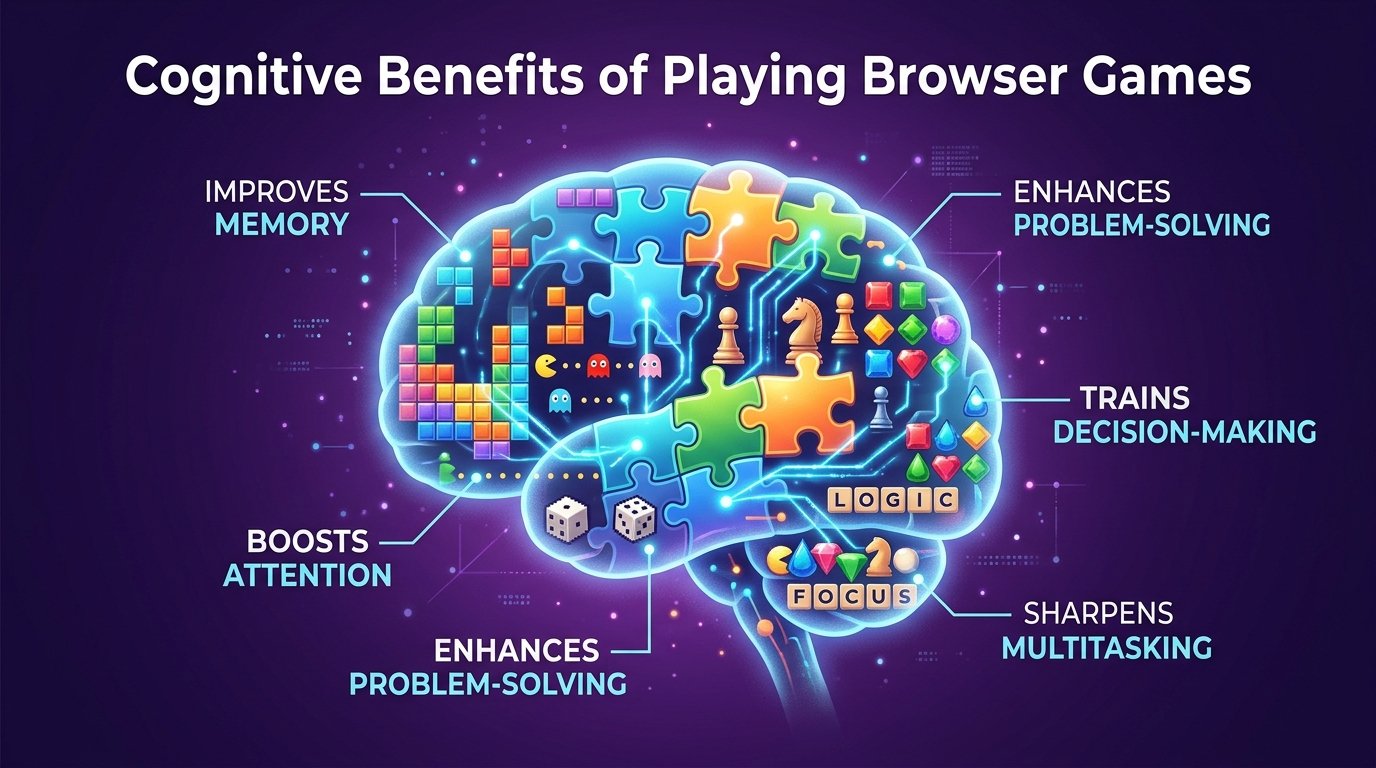
Cognitive Benefits of Playing Browser Games
I've always justified my gaming habits by telling myself it's "good for my brain." Usually, this is just an excuse to play one more level instead of doing the laundry. But recently, I actually looked into the science behind this, and it turns out... I was kind of right? Obviously, mindlessly clicking things for five hours isn't going to turn you into a genius. But there's actual research showing that playing specific types of casual games is basically like taking your brain to the gym.
Your Short-Term Memory Gets a Workout
You know that feeling when you walk into a room and completely forget why you went in there? That's your working memory failing you. It's the short-term storage space in your brain, and casual puzzle games are surprisingly good at expanding it.
Take a game like 2048. You can't just swipe randomly and expect to win. You have to remember where your big numbers are, calculate the next three moves, and keep the whole board state in your head while you plan. By forcing your brain to juggle all this information, you're literally strengthening the neural connections in your prefrontal cortex. It's like doing reps with a dumbbell, but for your memory.
Faster Reactions (In Real Life)
Action games get a lot of flak, but they are incredible for your processing speed. When you're playing a fast-paced game, you have fractions of a second to see a threat, process what it means, and physically click or tap to avoid it.
The wild part is that this doesn't just make you better at the game. Studies show that people who regularly play action games react faster in real-world situations, too. Think about driving—if a car suddenly swerves into your lane, those milliseconds of improved reaction time you built up while dodging lasers in a browser game might actually help you hit the brakes faster.
Thinking in 3D
Spatial reasoning is basically your ability to look at objects and understand how they fit together. It's what you use when you're trying to pack the trunk of your car before a road trip, or when you're trying to build IKEA furniture without losing your mind.
Games where you have to rotate falling blocks (you know the one I mean) or fit weird geometric shapes onto a grid are the ultimate training ground for this. Your brain has to visually rotate the object before it even lands. Doing this over and over actually thickens the part of your brain responsible for spatial processing. Next time you perfectly pack your suitcase on the first try, you can thank your gaming habit.
Learning to Focus Again
I don't know about you, but my attention span has been absolutely destroyed by social media. It's hard to focus on one thing for more than five minutes. But when I'm playing a challenging game, I enter this weird state of hyper-focus. Psychologists call it "flow."
The beauty of well-designed browser games is that they hit the sweet spot between being too easy (boring) and too hard (frustrating). When you're in that zone, external distractions just fade away. Practicing this sustained attention for 15-minute bursts actually trains your brain to resist distractions, which makes it easier to focus when you go back to doing real work.
Bouncing Back from Failure
Problem-solving in real life is messy. But in logic games, it's a tight, fast loop: you try something, it fails, you instantly see why, and you try a new strategy. You don't have time to get upset about failing because the restart button is right there.
This builds mental flexibility. You learn not to get stubbornly attached to one way of doing things. If a strategy doesn't work, you pivot. That kind of adaptive logic is incredibly useful outside of gaming. It teaches you to look at problems as puzzles to be solved rather than walls you can't get past.
How Much Should You Actually Play?
Look, moderation is still key. Playing for 6 hours straight will just give you eye strain. Here's what I've found works best based on the studies I read:
- 15-Minute Breaks: If you're an adult staring at spreadsheets, a 15-minute puzzle game during lunch is perfect to reset your brain.
- Keep It Challenging: If a game gets too easy and you're playing on autopilot, you aren't getting the cognitive benefits anymore. Move on to something harder.
- Stop If You're Mad: The benefits happen when you are challenged but engaged. If you want to throw your mouse at the wall, it's time to close the tab.
Some Quick FAQs
Does this really improve memory?
Yeah, puzzle games specifically force you to hold information in your short-term memory, which exercises those mental muscles.
How long do I need to play?
Honestly, short bursts of 15 to 20 minutes seem to be the sweet spot for brain stimulation.
What's the best game for this?
Tetris-style block games are amazing for spatial reasoning, while fast-paced games are better for reaction times.
Try These Brain Workouts
If you want to justify your next gaming break, try some of the games that actually make you think. Play 2048, Play Tetris, Play Sudoku